As The Business Times (BT) marks its 50th anniversary in 2026, the paper’s six flagship awards programmes offer a precise chronicle of how Singapore’s economy has matured — and which institutions have helped define what business excellence looks like at each stage of that journey.
From a Single Award to Six Distinct Programmes
BT has been reporting on Singapore’s business community since its first issue on 1 October 1976. Its formal role in recognising business leadership began in 1985, when it launched the Businessman of the Year award — now the centrepiece of the Singapore Business Awards. Over the following four decades, BT added five further recognition programmes, each timed to reflect what the economy most needed at that point.
The sequence runs as follows: individual leadership was foregrounded in 1985; SME growth became the focus when the Enterprise 50 Awards were established in 1995; corporate governance came into view with the Singapore Corporate Awards in 2005; startup ambition was addressed when the Emerging Enterprise Awards launched in 2008; sustainability entered the framework with the Sustainability Impact Awards in 2023; and artificial intelligence and technology were recognised when the Design AI and Tech Awards were introduced in 2024.
None of these programmes were built by BT alone. Each has been sustained through a formal partnership with an institution that shares the paper’s position that public recognition raises industry standards. Partners across the six programmes include DHL Express Singapore, KPMG in Singapore, OCBC, the Singapore Institute of Directors, the Institute of Singapore Chartered Accountants, UOB and the Singapore University of Technology and Design.
Singapore Business Awards: Four Decades of Uninterrupted Recognition
The Singapore Business Awards (SBA), jointly presented by BT and DHL Express Singapore, is described by BT as Singapore’s longest-running business accolade. It began with a single Businessman of the Year category in 1985 and has since grown to five categories: Businessman of the Year, Outstanding Chief Executive of the Year, Outstanding Overseas Executive of the Year, The Enterprise Award, and Young Business Leader of the Year.
The first recipient of the Businessman of the Year award was Michael Fam, who received the accolade from then Deputy Prime Minister Goh Chok Tong, according to BT’s records.
The programme has been presented every year without interruption — including through the Covid-19 pandemic. At the 35th edition in 2020, BT and DHL Express Singapore adapted the event to a hybrid format, with then Deputy Prime Minister Heng Swee Keat attending as guest of honour alongside a reduced in-person audience and hundreds of virtual participants. Christopher Ong, managing director of DHL Express Singapore, described that year’s event as “a powerful reflection of the values that DHL and BT have long shared: resilience in the face of adversity, adaptability during times of change, and a commitment to recognising business excellence no matter the circumstances.”
Enterprise 50: A Benchmark for Singapore’s Private Companies
Established in 1995, the Enterprise 50 (E50) Awards recognise the 50 most enterprising privately held Singaporean companies contributing to economic growth at home and abroad. The programme is jointly organised by BT and KPMG in Singapore, with OCBC serving as principal sponsor — a role OCBC has held since 2006, according to the source article. (OCBC’s own account cites 2005 as the start of its sponsorship; the precise year is not confirmed independently here.)
The programme’s reach is significant. More than 700 companies have been recognised across its three decades, and over 140 E50 alumni have gone on to public listings, according to BT’s reporting as of September 2026.
Chiu Wu Hong, partner and head of private enterprise at KPMG in Singapore, noted that the qualitative assessment process puts judges in direct contact with founders and management teams. “Behind every submission are stories of resilience, reinvention and ambition,” he said, adding that E50 serves as “a record of how Singapore enterprises continue to adapt, innovate and create positive change.”
One company cited in BT’s coverage is Pollisum Group, which placed second at the 31st edition of E50 in 2025. Founded more than four decades ago as a crane repair business, the company has since expanded into heavy-lifting, transportation, maritime logistics and steel fabrication under its second-generation leadership — an example of the kind of business transformation the awards have consistently spotlighted.
Elaine Heng, head of global commercial banking at OCBC, characterised the bank’s involvement as extending beyond sponsorship: “We are a longstanding and trusted banking partner to SMEs, serving as a bridge and connector as businesses grow from early expansion to regionalisation and international growth.”
Corporate Governance, Startups, Sustainability and AI: The Later Programmes
The four remaining programmes are not covered in depth in the supplied source, but their launch dates establish the editorial logic clearly. The Singapore Corporate Awards, introduced in 2005, brought corporate governance into the recognition framework at a moment when regional and global attention to boardroom accountability was rising. The Emerging Enterprise Awards, launched in 2008, created a category for startup-stage ambition. The Sustainability Impact Awards, begun in 2023, acknowledged that environmental and social responsibility had moved from peripheral to central in how Singapore companies are evaluated. The Design AI and Tech Awards, introduced in 2024, reflect the current weight placed on artificial intelligence capability as a competitive differentiator.
The partners for these programmes — the Singapore Institute of Directors, the Institute of Singapore Chartered Accountants, UOB and the Singapore University of Technology and Design — are named in BT’s coverage, though the specific roles of each partner within their respective programmes are not detailed in the supplied source material.
What the Awards Collectively Represent for Singapore
Taken together, BT’s six programmes amount to a structured, institution-backed record of what Singapore has judged worth recognising in its business community at any given decade. The progression from celebrating individual leaders in the 1980s to rewarding AI capability in the 2020s maps closely onto the economy’s own strategic pivots — from export-led manufacturing and trading, through SME development and capital-market deepening, to today’s priorities of sustainability and digital transformation.
The longevity of the oldest programmes — SBA running uninterrupted for 41 years by 2026, E50 now in its fourth decade — also signals something about the stability of the partnerships that underpin them. Recognition programmes that depend on annual renewal from institutional partners tend to reflect genuine alignment rather than short-term marketing interest.
For Singapore business leaders and the companies they run, these programmes represent a consistent external benchmark — one that has evolved alongside the economy and shows no sign of narrowing its scope. The addition of AI and technology as an award category in 2024 suggests BT and its partners intend to continue tracking the economy’s leading edge rather than consolidating around established sectors. How the Sustainability Impact Awards and Design AI and Tech Awards develop their own alumni networks and influence — the way E50 has built a cohort of over 140 listed companies — is the part of this story still being written.
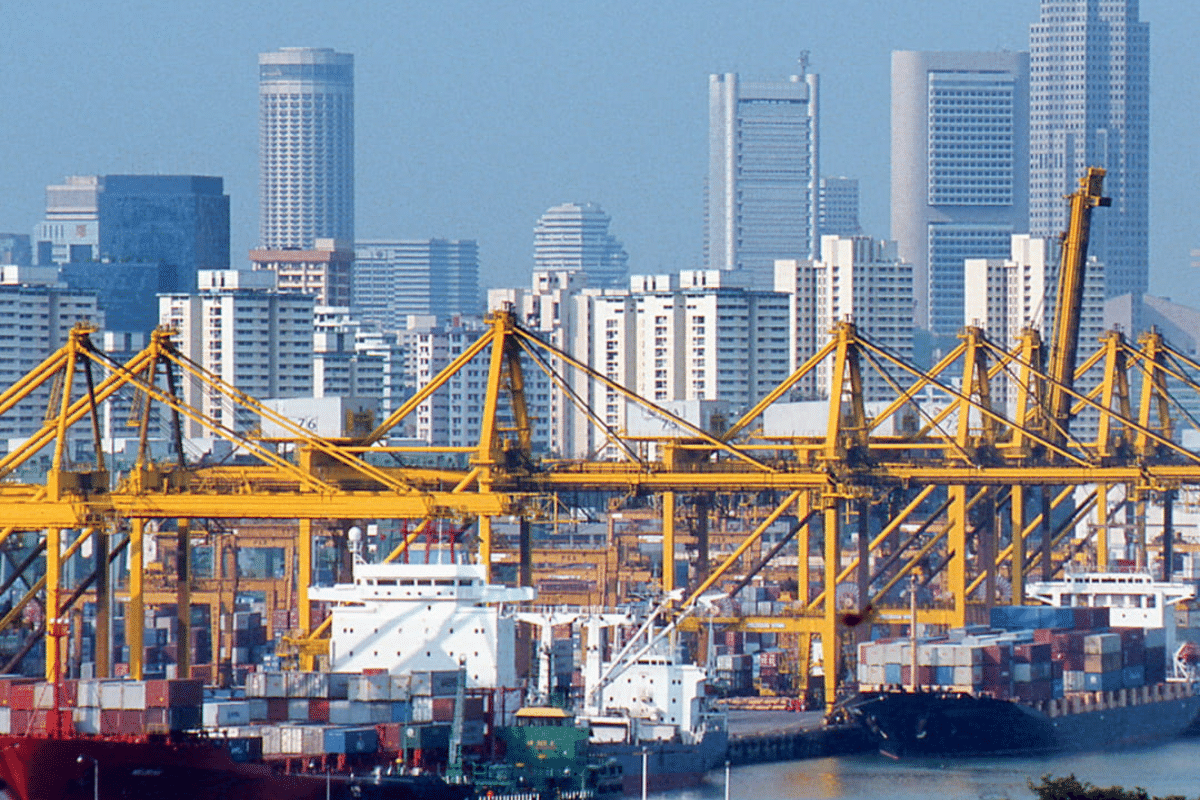
Illustrative photo: Singapore Skyline-01.jpg by CEphoto, Uwe Aranas / Wikimedia Commons. CC BY-SA 3.0. Resized for display.